A finished flagstone patio can look deceptively effortless. Broad pieces of stone settle into the yard, the joints wander a little, plants soften the edges and nothing looks like it came out of a mold. Halfway through installation, the experience can be considerably less romantic. One piece is thicker than the last one. Another almost fits the opening but needs to turn 90 degrees. The big piece you were certain belonged beside the steps rocks every time someone puts weight on one corner.
Most of the pros and cons of flagstone come from the same fact: it is natural stone. Pieces vary in thickness, color, texture and shape. Installation requires more judgment than laying a modular paver, but the finished surface can have a character that manufactured materials have a difficult time reproducing. The Natural Stone Institute also emphasizes that performance depends on more than appearance. Stone type, climate, soil conditions, site preparation and installation method all play a part in how well exterior paving holds up.
So the better question may not be whether flagstone is good.
It may be whether you are a flagstone person.
First, “Flagstone” Doesn’t Tell You as Much as You Think
Flagstone describes a format rather than one specific type of rock. Sandstone, quartzite, slate, bluestone and limestone can all be quarried or split into broad, relatively flat pieces and sold as flagstone. The underlying stone still determines important things about strength, weathering and suitability for a particular climate. Thickness varies as well, which becomes especially important once installation begins.
The Rock Garden in Northern Colorado carries several flagstone selections, including Colorado Red, Cowboy, Smoke, Santa Fe Buff, Watermark Buff, Black Beauty and New Mexico flagstone. Even within one named selection, expect natural changes in color, edge shape and surface character. That is one reason looking at an entire pallet tells you considerably more than looking at one sample stone.
If that variation sounds interesting rather than irritating, you are off to a good start.
You’ll Probably Love Flagstone If You Like Things That Aren’t Perfectly Matched
Think about hardwood floors. Some people open several boxes before installation and deliberately mix the boards because they want the grain and color variation spread throughout the room. Other people pull out the board with the dark streak because it doesn’t match the sample.
The first person will probably have an easier relationship with flagstone.
One stone may be warmer than the next. Another may have a rust-colored streak, a darker bedding line or an edge unlike anything around it. Irregular flagstone adds another layer because the shapes don’t repeat either. For many people, those differences are the main reason to use natural stone. A large patio can have hundreds of pieces without revealing an obvious manufactured pattern.
Someone who wants to approve one 12-inch sample and know exactly what the next 500 square feet will look like may feel differently. Photographs also tend to flatten the very characteristics you need to judge. Surface texture, piece size, thickness and subtle color differences become much easier to understand when you are standing beside the material.
The Work Starts After the Stone Arrives
Todd Darnell, a stone professional quoted by Use Natural Stone, summed up installation pretty well: “After you get your stone, then the work really begins.”
He wasn’t exaggerating. A manufactured paving system gives an installer a repeated module. Irregular flagstone gives the installer a pile of possibilities. Pieces get moved, rotated and sometimes trimmed. Bedding material gets added under one edge and removed beneath another. The installer is constantly deciding which irregularities add character and which ones will create problems later.
The difference becomes obvious when furniture shows up. A beautiful stone that rocks underfoot becomes annoying. A high edge in a common walking route eventually finds somebody’s toe. A low spot under the dining table becomes the place water collects after every storm. Good installation can produce a remarkably comfortable surface despite everything irregular about the raw material, but getting there takes time.
For a loose garden path or a handful of stepping stones, that extra labor may be manageable for a homeowner. A large patio beside the house, where drainage matters and dining chairs need to stay level, is a different project.
You May Regret Flagstone If Perfect Joints Make You Happy
Some people want every joint to be exactly the same width. I understand the appeal. It looks controlled and photographs beautifully. Irregular flagstone is not always interested in cooperating.
A skilled installer can keep joints from becoming distracting, but forcing every irregular piece into a highly uniform pattern starts to work against the material. Dimensional flagstone is available for projects that need straighter lines and a more orderly grid, and it can be a better fit for contemporary architecture or anyone who simply prefers more structure.
I also tend to like larger pieces when the project and budget allow them. Bigger stones mean fewer joints, and a large patio can feel calmer because the surface is not broken into hundreds of little fragments. Smaller pieces have their place, especially on winding paths or intimate garden areas, but using them everywhere can make a broad patio busier than it needs to be. The original material guidance similarly notes that substantial pieces tend to reduce visual interruption across larger surfaces.
Colorado Makes the Installation Question More Important
Flagstone on the Front Range has to tolerate repeated freezing, thawing and soil movement. Base preparation, drainage and compaction matter because the stone is only as stable as the system underneath it. Expansive soils common in parts of Colorado add another reason to take that work seriously.
Homeowners naturally spend most of their shopping time looking at the top of the stone. Contractors tend to spend much more time thinking about what will be underneath it. A beautiful flagstone cannot compensate indefinitely for poor drainage or a weak base. Problems may not show themselves during the first summer, either. A few Colorado winters can be much more revealing.
Local experience counts for that reason. A stone with a successful history in a freeze-thaw climate tells you more than a patio photograph taken somewhere with completely different soils and weather.
You’ll Probably Love Flagstone If Patina Doesn’t Scare You
Flagstone does not depend on looking freshly installed forever. Plants begin to creep toward the joints. Nearby shrubs fill in. Surfaces weather slightly, and little color changes make the patio feel less recently constructed. Natural stone can have a long service life when the material and installation are right for the application, and some of the visual changes that come with age actually help it settle into the landscape.
Maintenance still exists. Dry-laid pieces can eventually need resetting, joints may require attention, and different stones react differently to staining and weather exposure. Anyone promising a completely maintenance-free natural stone patio is oversimplifying things.
For some homeowners, even minor change feels like deterioration. Others like the fact that a patio becomes less pristine and more established over time. Flagstone tends to make the second group happier.
Dry-Laid or Mortared Changes the Conversation
A surprising number of complaints blamed on flagstone are really complaints about the installation system.
Dry-laid flagstone rests on a prepared base rather than being permanently bonded to a concrete slab. Individual stones can be lifted and reset when necessary, and the finished patio can have a relaxed character that fits naturally into planting beds and gardens. The trade-off is movement. Joints may need occasional attention, weeds can find opportunities and settling can eventually require adjustment.
Mortared flagstone belongs to a more rigid system, typically over concrete. It can create tighter joints and a more controlled walking surface, but repairs become more involved and the assembly has less ability to accommodate movement below it.
Neither method automatically wins. A formal courtyard, an informal garden path and a heavily used dining patio may call for completely different decisions. Soil, drainage, climate and how people plan to use the surface should carry more weight than a contractor’s favorite installation method.
Texture Looks Different Once a Dining Chair Is Sitting on It
People understandably choose flagstone with their eyes. Your feet and patio furniture deserve a vote too.
Some stone has a relatively restrained natural cleft. Other material has deeper texture, ridges and low spots that look fantastic when late-afternoon light moves across them. A rougher surface can be beautiful on a garden path where the texture contributes to the character. Under a dining table, that same stone can make furniture placement more complicated.
Color gets most of the attention at a stone yard because it is easy to compare. Surface character can matter more after installation. The original material notes the same difference: heavily textured flagstone may add visual interest in informal landscaping but can become less convenient around furniture and heavily traveled areas.
You’ll Probably Love Flagstone If You Hate Seeing a Pattern Repeat
Manufactured paving has become very good, but many products eventually reveal the module. Once you notice the recurring shape, you tend to keep seeing it.
Irregular flagstone avoids that almost completely. The pattern gets built as the patio goes together, giving the surface a much less repetitive rhythm. That characteristic works especially well where paving needs to transition into stone steps, boulders, planting beds or a looser garden path.
Flagstone can also become considerably more disciplined when the architecture calls for it. Dimensional pieces create straighter lines and more controlled joints while keeping the natural color and texture changes in the stone itself. A contemporary house does not need to give up natural stone simply because a loose, rustic layout feels wrong.
Choosing between those approaches is another reason to visit a flagstone supplier rather than making the decision from one close-up photograph. Look at the size distribution across a pallet. Step back 20 feet. Put two selections beside each other. Pay attention to the surfaces as much as the colors. A material that looks too varied online may make perfect sense once you see it at actual scale.
You May Not Be a Flagstone Person If Furniture Wobble Will Ruin Your Evening
A properly installed flagstone patio should be comfortable to walk across, and installers put substantial effort into keeping neighboring stones in a useful plane. Natural cleft still means the surface may have more variation than porcelain or a precisely manufactured concrete paver.
Some people barely notice.
Others will find the one chair position where a leg doesn’t sit perfectly and spend the rest of dinner thinking about it.
Neither person is wrong. They probably need different patios.
One of Flagstone’s Best Qualities Is How Easily It Moves Into the Landscape
Some patios feel like rectangles dropped onto the yard. Flagstone can make the transition softer.
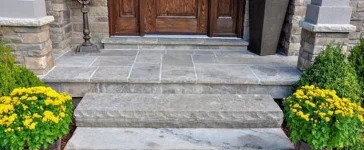
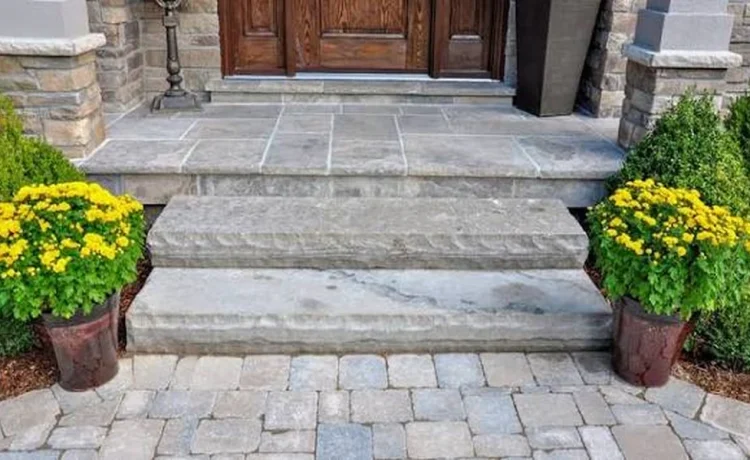
Pieces can continue beyond the main patio as stepping stones. Joints can loosen near planting beds. Groundcover can creep toward selected edges. The same stone can appear again in a set of steps or a small landing without requiring another product entirely. Natural edges are especially useful where a path needs to disappear into planting rather than end abruptly at a perfectly straight line.
That versatility makes flagstone particularly useful when the goal is to connect the hardscape to the rest of the property. The patio remains a constructed surface, but it doesn’t have to shout exactly where the construction ends and the garden begins.
You’ll Regret Buying Flagstone by Color Alone
“Which one do you like better?” is a reasonable question at a stone yard. It just shouldn’t be the only one.
Ask what kind of stone you are looking at. Ask about thickness. Explain what you plan to do with it. Mention if the project will be dry-laid or mortared. Ask how the material performs in freeze-thaw conditions. Look across the whole pallet instead of choosing based on the prettiest piece sitting on top. Industry guidance consistently stresses that the word “flagstone” by itself does not tell you enough about performance.
Samples help, but even samples have limits. Natural stone never promises to duplicate itself exactly.
So, Are You a Flagstone Person?
Flagstone probably suits you if natural variation looks better than perfect repetition, you don’t need every joint to match, and you like the idea of a patio becoming more settled as the surrounding landscape matures. You should also be comfortable with an installation that requires more field judgment than a highly standardized paving system.
You may be happier with something else if precise uniformity is a priority, slight differences in surface texture bother you or your main goal is the simplest, most predictable installation possible. Manufactured pavers solve many of those concerns very well. Choosing them is not settling. It means choosing the material whose strengths fit what you care about.
My favorite flagstone patios look controlled in the places where control matters. Water drains correctly. Stones stay put. Walking feels comfortable. Chairs work. Beyond those fundamentals, the material gets a little freedom. Colors change from one stone to the next, joints wander, plants soften the edges and a particularly good piece gets to look different from everything around it.
For the right person, those aren’t compromises. They’re the reason to choose flagstone.